
What a Child Learning to Ride a Bike Can Teach Us About Success
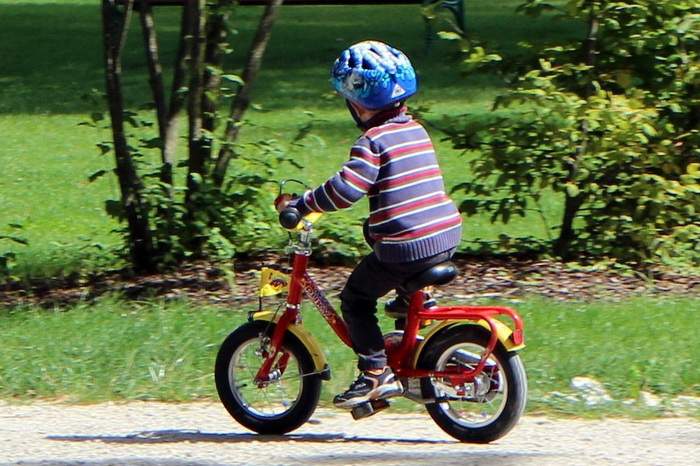
Of course, if you know how to ride a bike, it will be very easy for you to accept my invitation: try to recall those early moments when you struggled to learn how to “master” this vehicle and, of course, how you managed to achieve that goal.
I think we can agree on the following “algorithm”:
first, you had to gain confidence in an object that seemingly couldn’t balance on its own, but reality proved that it could still be used as a very simple means of transportation.
Obviously, you’ve had various opportunities to see others mastering this “wild horse,” but it was time for your own impressions to turn into convictions, so that you could share in the experience of others.
The second challenge was gaining the courage to gradually let go of the support while simultaneously developing the dexterity to maintain your balance solely through the momentum created by applying your own strength.
A third stage marked the transition to “refinement.” You had to learn to lean when approaching curves, fighting against the natural tendency that urges you to avoid what seemed like a dangerous situation. If you hadn’t had the success of others as proof, would you ever have believed that the “system”—the surest way to avoid failure (falling)—is not the option of “staying on the sidelines,” but rather the courageous approach to the curves?
After overcoming the obstacles described above, I’m sure you were tempted by the possibility of taking “breaks.” You discovered, however, that while it was possible to rest a little from time to time, without getting back on the bike you wouldn’t have gotten very far.
Finally, more important than anything else, you discovered that if we want to reach our goal, the clear necessity was to get back on the bike after every fall. No matter how painful a particular fall might have been, it was just part of the price we had to pay to get what we wanted—the ability to ride a bike.
From time to time I think about the impressive number of books, programs, seminars, and manuals on systems for achieving success (whatever that term may mean to you), each presenting “recipes” (often of highly questionable usefulness), and what results we might achieve instead if we tried to tap into that part of ourselves that “knows” exactly what to do and which, if not blocked by doubts, criticism, suspicions, and anxieties, would inevitably lead us to success. In other words, what would happen if we tried to tap into “the child within us who, once upon a time, learned to ride a bike.”
As for me, I find this metaphor very evocative, which is why I suggest we analyze it in detail.
First of all, to learn to ride a bike, you had to know that there is something called “riding a bike,” to understand what that something means, and of course to decide that you want that something to become part of your experience. Natural? Of course.
It’s clear that we can’t want and achieve something if we don’t know what it is or what it means.
But, incredibly, in everyday life, ignoring this subject is one of the most common obstacles to our success.
Most of us, under the pressure of thousands of daily tasks and bombarded by a massive amount of advertising messages about success and social achievement, end up having no clear idea of what we’re working toward.
We all want success, but if you were to conduct a little test on yourself and those you know, you’d discover that very few people can give you a correct answer to the question, “What does success mean to you?”
If the answer is, as is often the case, “a lot of money,” dig a little deeper into the subject and you’ll find that most people have no idea what to do with it.
Don’t believe me? Ask someone what they’d do with, say, 10 million dollars, and in nine out of ten cases you’ll get this answer: “A villa or two, maybe with a pool, two Mercedes and a Jeep, a ton of clothes, electronics, trips abroad, the company of attractive women… and usually that’s where the fantasy ends.
Unless you’re talking to a real businessman, who’s used to treating money for what it is—a tool for work—you’ll find that almost everyone would do with the money what the “overnight millionaires” did: nothing smart.
What can we do to avoid the path to failure?
Nothing more than following a logical sequence in our efforts.
Are you ready? Good… let’s start with the first step: the ability to…
choose motivating goals
… is such an important quality that it forms the foundation of any success, any personal achievement, and we will explore this topic in detail in a future article. For now, I suggest we keep in mind that an effective “journey” requires a well-defined goal. Otherwise, it is merely a waste of time.
Perhaps we simply enjoy walking, one might argue, but of course in that case we shouldn’t be surprised if we end up in a “place” we don’t like. Assuming we have decided on a goal, on a “destination” toward which we focus all our energy and resources, let’s return to what “the child within us” teaches us. It is necessary…
to trust the process
… in achieving the goal we have set for ourselves. This idea has been expressed so many times that it seems to have become a cliché, but it remains one of the eternal laws of success: if you are not convinced that what you are doing will succeed, you will not be able to focus your energy on the goal.
What kind of commitment can drive a task about whose completion we have doubts? For the same reason, without a foundation of confidence, you will never have the courage to…
leave your comfort zone
No assessment based on the experiences of others can replace your own action—and, of course, the risk it entails.
Even if you take the time to observe, evaluate, measure, and control, at some point you must “get on the bike and ride,” with all the risks that entails. From that moment on, all the analyses you have undertaken will become mere theory.
The next item on the list of concerns must be acquiring the ability to…
lean into curves
in many situations, the safest and most effective course of action is precisely the one that appears to be more difficult and dangerous. Trying to avoid risks can become a source of trouble.
Any goal you wish to achieve involves navigating situations where you will truly find yourself in an “unstable balance.”
To come out “scot-free,” you must have the ability to face and master these situations.
This is part of the price we must pay to achieve that goal. Trying to find a way to avoid such situations is, in a way, similar to trying to sit upright in the seat when entering a curve—that is, the surest way to veer off course. Next…
keep pedaling
… a necessity that I don’t think needs any further explanation. Despite some idiotic commercials and TV shows that tell us how some people get rich “overnight,” success without constant effort is not possible.
If we look at the lives of truly successful people—not parasites and thieves—we’ll find individuals who, despite having fortunes in the millions or billions, maintain an impressive work ethic: movie stars, great champions, industrialists, politicians, and successful writers don’t finish their workday at 5:00 p.m. Finally, we’ve reached the point of…
getting back in the saddle
Over the years, I’ve been fortunate enough to meet a large number of successful people, many of whom are public figures. Well, I’ve found that none of these people succeeded on their first try.
To put it better, they all experienced failures, bankruptcies, setbacks, and frustrations, but they always found the strength to get back in the game until they found the path that led them to success.
The ability to react positively to failure (which I’ve already written about) is perhaps the most valuable of the qualities we would do well to acquire.
Imagine how strange it would seem to you if you heard a child say something like, “I’m giving up! I don’t want to risk falling again; I’d rather leave the bike and walk.”
Of course, many of us will continue to look for “secrets”—maybe even “shortcuts”—on the path to achieving our goals.
However, I, at least, have never met a person who achieved success without paying a price for it.
Watching those who try to “cheat” and who ultimately give up, I can’t help but think of the wonderful results we could achieve if we tried to invest in our endeavors the courage, confidence, and—why not—the stubbornness of a child who wants to learn to ride a bike…


