
Self-Knowledge and the Meaning of Life
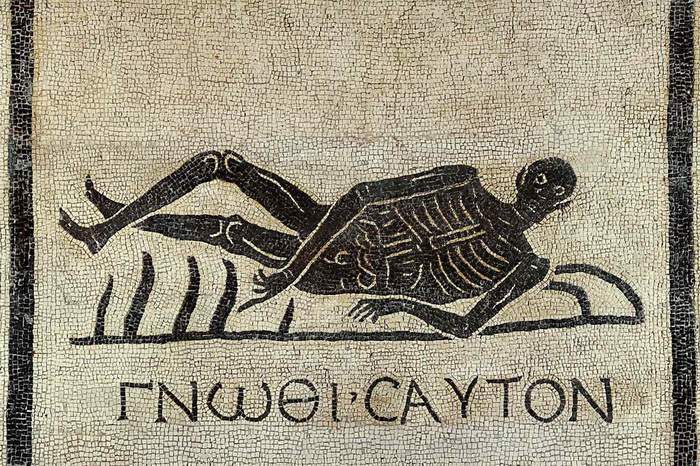
There is a story from the recent past about a Christian monk who went to visit a Tibetan lama with the intention of exchanging knowledge, discovering the spiritual path of such a distant culture and learning more about their ways of praying and meditating.
In response to a direct question on the matter, the lama explained that the ultimate goal of any method of meditation is to attain a state of presence and cosmic consciousness, in which divinity no longer exists, but only pure awareness of one’s own existence remains.
The Christian monk, surprised and indignant, replied, “That strikes me as an aberration and a mistake. I believe that the ultimate goal of all meditation and prayer should be the dissolution of one’s own being and the absolute perception of God’s existence!”
“Oh, well, it’s exactly the same thing,” replied the lama.
Know Thyself
Γνῶθι σεαυτόν (gnōthi seauton, know thyself) is the famous maxim that pilgrims found at the entrance to the Temple of Apollo at Delphi in Ancient Greece. A maxim that at first glance might seem trivial, but which, on the contrary, represents the highest pinnacle of knowledge: as another philosopher of that time wrote, “to know yourself is to know the universe and the gods.”
The Question That Never Goes Away
But what does “knowing oneself” mean, and what else should we discover that we do not already know, given that, apparently, we are in touch with ourselves 24 hours a day? Sometimes, the quickest way to arrive at the truth is by process of elimination: as Sherlock Holmes explained to his assistant, “Once the impossible has been ruled out, whatever remains, however improbable, must be the truth.” So, we begin to ask ourselves, “What are we not?”
What Are We Not?
“I am not my hand. Just as I am not my knee or my liver. Language itself highlights the separation that exists between “I” and the components of my body, and therefore it is easy to admit that “I” am not my body, especially since cells are constantly changing and, in unfortunate cases, parts of the body can be lost without the sensation that the “self” is somehow affected.
In the same way, “I” am not my thoughts, which are constantly changing, just as I am not my emotions. Nor am I my culture, my memories, or my creations, which are all temporary and even more fleeting than organic matter. Even less can I identify with my job, my position, my money, my social circle, or all such things whose transience is obvious.
A reporter interviewing Mother Teresa of Calcutta:
“You must certainly pray a lot. What do you say to God?” “I say nothing; I just listen.”
“Ah! And… what does God say to you then?” “He says nothing; He just listens.”
Beyond Body, Thoughts, and Emotions
But if all these things are not there, what remains of the concept of “I,” once matter, thought, emotions, personality, and all the other things with which—for convenience’s sake—we usually identify ourselves have been set aside? (Note: In Roman theater, a “persona” was the mask worn by an actor who had to play a specific role. It makes you think, doesn’t it?)
This is a question that humanity’s greatest minds have asked themselves since the beginning of time, and the desire to discover what lies beyond the veil of impermanence is precisely the goal of every religion, every meditation technique, and every spiritual path. And, beyond the apparent variety, every method of meditation involves putting yourself in a state where you forget you have a physical body, the constant turmoil of the mind subsides, emotions fade until they disappear, and, finally, you find yourself…
…exactly: what do you find?
The answers given to us by mystics, philosophers, and spiritual guides have been incredibly varied, based on the belief systems we refer to; but, again, when you look beyond the surface of the metaphors used and focus on the deeper meaning, you realize that everyone is talking about the same experience: when you set aside what is transitory and are able to connect with your own higher self—with the transpersonal aspect—you enter a dimension of pure awareness that transcends the physical body, transcends emotions, transcends thought, and transcends the ordinary concept of space-time; and it is precisely in this dimension that we find not only the answer to the question “who am I,” but also all the answers that give meaning to the other dimensions; in fact, we enter the realm of the spirit that “knows,” that knows all the answers, the realm where, in fact, ordinary questions—with the baggage of doubts that trail behind them—no longer arise because they lose their meaning.
Meeting the Higher Self
Obviously, the path to self-knowledge is full of pitfalls and obstacles, as anyone who has embarked on it knows; the ego—which refuses to be set aside—presents us with the temptations of vanity, envy, and pride. Not only that, but moving toward self-knowledge means overcoming the wall of lies we’ve built around ourselves to protect ourselves; it means admitting the real intentions behind our actions; it means confronting our fears and hidden desires; it means encountering our “shadow,” a process that can lead to discoveries and realizations that may be very painful.
Encountering the Daimon
This is what many cultures call the “night of the soul,” a moment when self-awareness drives us to let go of what “is not me” in order to move toward new certainties that have not yet taken root. And it is precisely in this space that we can find our most authentic essence, in the form that the ancient Greeks called “daimon” (δαίμων), unrelated to the word “demon” as it was later understood by Christianity: in fact, the Latin translation was “genius,” and both words refer precisely to our purest spiritual essence, to the “god within us”.
So, encountering your “daimon” means discovering enthusiasm – derived precisely from “en theos,” (ἐν θεός) the god within you-, and allowing your personal daimon to manifest itself means attaining eudaimonia (εὐδαιμονία) —that is, the full realization of the self— it means unleashing our true essence, it means discovering the meaning of life (note, as I repeat at every opportunity, that in Italian and other Romance languages, the word for “meaning” is “senso”, and can be used as “direction” and as “significance”).
Rediscovering Authenticity
When we experience a lack of meaning—that is, when we feel that our life lacks “significance” and “direction”—we can be certain that we have stifled our genius, that we have hidden our true essence in order to conform to society’s expectations, and that we have lost our authenticity, and here again, etymology comes to our aid: from “autos” (αὐτός) the one who responds to oneself.
The path to discovering our own essence, our own uniqueness, can certainly be difficult and painful. But if we want an authentic life, a life with “meaning,” it is the only path worth taking.
by Bruno


