The Secret Power of Words: How Language Shapes Your Mind
Without a doubt, an individual’s ability to communicate is an indispensable prerequisite for success in any field. For thousands of years, philosophers and orators have made the study of language a primary focus in order to uncover the secrets that constitute its power.
Even though we now include elements such as tone of voice, gestures, and eye contact in the concept of communication—elements whose importance is, of course, extraordinary—it remains undeniable that sentences, or verbal patterns constitute the backbone of communication.
Words are the “building blocks” of language, and consequently, mastering their meaning is an indispensable prerequisite for anyone who aspires to become a good communicator.
You would undoubtedly say that this is nothing new, since each of us, especially when sending a written message, naturally pays close attention to choosing the most appropriate words so that we can ensure the best possible chance that the recipient will understand what we want to communicate and act accordingly.
What is surprising, however, is that we become so focused on how we can use words to influence others that we always forget their extraordinary power to influence us, the ones who apparently “use” them.
This is what I want to talk to you about in the following lines.
The Hidden Power of Words
Words… They are perhaps the most powerful weapon at our disposal: through words, we can make someone laugh or cry, dream or suffer; we can bring a person moments of happiness or despair.
History offers us thousands of examples showing that, throughout the ages, great figures have used words to bring people to their side and change the course of destiny.
Of course, it is also through “well-chosen” words that poets and writers have conveyed to us the vastness and extraordinary emotional message of living through a particular era, of a generation’s experience.
How else, other than through the writings of figures like Balzac, Tolstoy, or Preda, could we have “lived” centuries or decades ago to better understand who we are today?
Language as a Tool of Influence
To try to explain the power of words to convey human experience and emotion, I propose we start from the following premises:
– every word is a symbol, or rather a synthesis of a description, which, to be understood, must share a meaning with the listener;
– every word is a tool used to make distinctions, to signal a difference: the richer the vocabulary, the richer the experience that can be conveyed, and vice versa;
– every word carries with it, in addition to its literal meaning, a certain amount of “parallel information” about the person using it: age, profession, cultural background, perhaps political views…;
– every word contains a judgment, an opinion about the object we are describing;
– in order to be understood, every word must be associated with a mental image, and, as a consequence, this image comes to mind every time we hear or use that word;
– if a word refers to an emotional state, in order to be understood it must be associated with that state, but this relationship can also work in reverse (this observation underlies the most powerful covert manipulation techniques, which we will have the opportunity to discuss in a future issue of the magazine).
The First Person Listening Is You
Based on these premises, if we agree that language, composed of words, has immense power over the recipient—the listener—it is surprising that we never consider something so obvious: the first ones to “hear” our words are… ourselves!!!
Of course, this isn’t limited to when we speak a message aloud.
From the moment we wake up in the morning, we set in motion a thought process that is, in fact, based on a verbal model.
We could even say that, in a certain sense, this process never stops, because when we sleep, control of its functioning is “handed over” to the subconscious.
Why don’t we ask ourselves: if certain words can provoke a negative reaction, an unpleasant state in our interlocutor, what might be the effect of this barrage—these verbal automatisms we constantly exercise—on ourselves?
How Words Shape Emotional States
My view is that we can speak of something very close to a form of “brainwashing” that we administer to ourselves!
I am not attempting here an in-depth analysis of the mechanisms underlying the word/image/emotion relationship, but I believe you will agree that, ultimately, there is nothing “real” in our minds, only a description—the image we have of it.
Let’s remember that this image is also created through words, and that every word carries parallel information and conveys an emotional state.
This will likely make it clear to us why we so often experience certain seemingly “inexplicable” phenomena: let’s take a moment to analyze which words we use most frequently and see if they contain information about our experience.
How often do we use words like “failure,” “frustration,” “problem,” and “bankruptcy” to describe a crisis situation?
Think about how much our assessment would differ if, instead, we used terms like: “challenge,” “opportunity,” “experience”?
Does it seem to you that this is just a way of playing with the meanings of words?
The Vocabulary of Successful People
I ask you to listen carefully when a successful person, a true leader, speaks: you will never hear such a person use words like “boredom,” “defeat,” “stress,” or “fatigue,” not even when talking about someone else: it seems these words are simply missing from their vocabulary.
What I wanted to convey is that in order to share an emotion or the meaning of a concept, we automatically make the mental connections necessary to “feel” it the moment it is spoken.
For example, to understand the word “red,” we automatically think of that color, and to understand the word “stress,” our mind automatically recreates the experience of stress with everything it entails. It’s likely that what I’ve told you doesn’t sound very credible, which is why I suggest we set theory aside and conduct an experiment:
A Simple Experiment in Mental Reframing
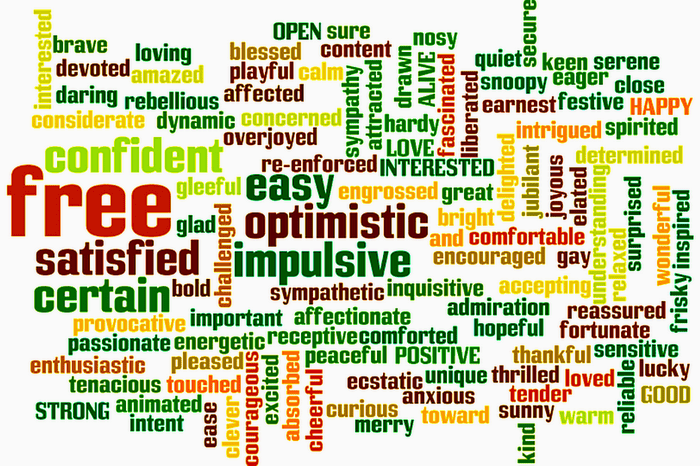
a) Look through the words you use very often and find three that contain a negative judgment about the object each describes; every time these words come to mind, try to replace them with others that are less “harsh” (see the list); once you’ve fully made this change—meaning you automatically use the alternatives to the “harsh” words—move on to a new set of three, and so on (generally, this “transition” process takes 7–10 days).
b) Replace three of the positive words you use most often with others that are more “enthusiastic,” perhaps even exaggeratedly positive.
As you “gradually climb this true ladder toward positive thinking”—which may now seem like a naive game, if not a tasteless joke—you will find that it is a reality.
Changing your usual vocabulary also brings about a change in the way you think, feel, and… live!
Two more things:
– Sometimes we’re tempted to slip into a negative state because of the situation we’re in. But I don’t think you can give me examples of people who managed to overcome a difficult situation by giving in to despair…;
– When I started learning Romanian, what struck me the most was the expression “nu va suparati…” as a way to get someone’s attention.
In my opinion, this explains, at least in part, why some people are irritable from morning till night.
I invite you to use a different phrasing, such as: “please be so kind…” or “please…” and I guarantee you’ll see an improvement in your daily interactions… Good luck!
Why Not Replace…
furious → agitated
good → extraordinary
depressed → tired
satisfactory → promising
surprised → fascinated
amazed → enthusiastic
happy → over the moon
stress → challenge
impatience → enthusiasm
determined → resolute
disaster → difficulty
problem → opportunity
beautiful → splendid
crazy → exuberant
spectacular → fantastic
jealous → possessive
out of his mind → worried
annoying → curious
Of course, these are just examples to get you started, because I have no doubt that each of you, with a little ambition, can find much more inspired “pairs.” Try it for yourself!


