
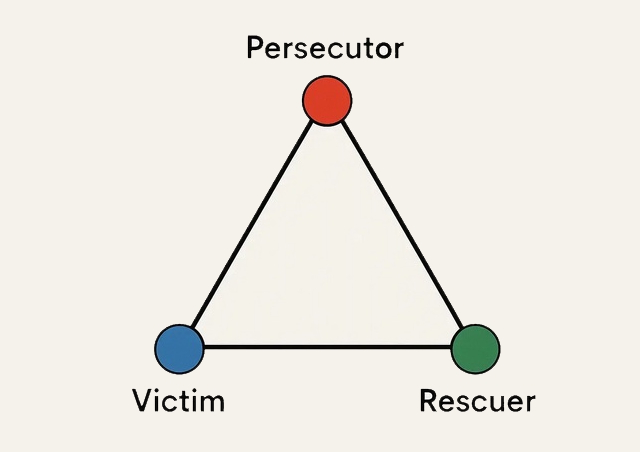
Persecutor, victim, or… rescuer?
– Ah… the youth of today! What will become of them?
– You’re absolutely right, that’s exactly it!
– What time is it? Seven.
– Where’s the red folder?
– If you were more organized, you’d know!
– Him: Come over to my place so we can listen to some music…
– She: Good idea…
I’ve listed here a few exchanges that you might hear and use thousands of times a day, deliberately chosen from the most mundane ones that came to mind.
If we define each of these exchanges as a “transaction” and attempt to analyze their meanings, we are engaging in what is known in scientific terms as “transactional analysis.”
What is Transactional Analysis (TA)?
Transactional analysis (TA) emerged in the 1960s through the work of an American psychotherapist, Eric Berne, with the aim of making the most complex concepts in psychology and psychoanalysis accessible to the general public, and it quickly gained traction at all levels of the business world (from salespeople to executives), due to its ability to easily address everyday and professional communication needs.
TA, even if it sometimes has the flaw of being simplistic, can be considered a true key to communication; I therefore wish to outline the main concepts, trusting as always in your ability to find examples and applications on your own.
Transactional Analysis includes:
– Structural analysis, which helps us understand the state of mind in which a person is operating.
– Transactional analysis, which delves into what happens in interpersonal communication exchanges.
– Life stance analysis, that is, the patterns people use, more or less consciously, in facing existence.
– Game analysis, which allows for the effective understanding and resolution of a series of typical situations.
Structural Analysis: The 3 States of the Self
A state of the self is defined as a system of thoughts, behaviors, and emotions that place each individual in relation to the environment (the environment may be another individual, a family, a group, or a company).
AT is based on the observation that each of us possesses a rational component (Adult state), an emotional component (Child state), and a component that stores the teachings and attachments received from parents, caregivers, and teachers (Parent state).
These three states of the self have no connection to actual age or kinship, but rather refer to behavioral patterns; we shift from one state to another depending on the situation.
But let’s look at the components of the self in detail.
The Parent State
This is a reflection of the upbringing received, which leaves its mark on childhood and adolescence, continuing to influence the adult individual.
The values transmitted relate to:
– right and wrong
– what you should do and what you shouldn’t do
– beliefs
– professional fulfillment
– marriage
– traditions, etc.
The Parent state is divided into:
– The Normative Parent, which refers to social norms and evaluation methods;
– The Affective (or Protector) is the one who protects, comforts, supports, and encourages.
Negative Normative Parent (NNP)
This refers to the parent who undervalues their child.
Ex.: “You don’t know how to do anything!”; “That’s not how you do it!”; “At your age, I was getting much better results than you!”…
The Positive Normative Parent (PNP)
This is the parent who gives orders and sets limits, making sure they’re followed.
Ex.: “Go to bed; you have to get up early tomorrow!”; “Stop stuffing your face or you’ll get indigestion”; “Say hello to the neighbor!”; “You mustn’t tell lies!”
In both cases, the tone is stern and the demeanor is cold and domineering.
The voice is sharp and harsh.
Advantages: It conveys moral principles, facilitating the individual’s integration into their social environment.
Disadvantages: Its rigidity can inhibit and stifle creativity and imagination.
Negative Affectionate Parent (NAP)
This is the overly affectionate parent, who becomes overprotective and hinders the child’s natural development.
Ex.: “I’ll do the work for you so nothing bad happens to you”; “That friend isn’t good for you.”
Positive Emotional Parent (PEP)
This is the parent who helps, advises, and cares for their child while respecting their autonomy.
Ex.: “That can be dangerous; wait until I teach you a safer way”; “It’s pretty cold today; you’d better wear something else.”
Physically, their gestures are generous and open. Their voice is warm, sweet, and soothing.
Advantages: It creates conditions conducive to the child’s natural and safe development.
Disadvantages: Overprotection can stifle and inhibit any initiative.
The Child’s State
Every individual carries with them traces of periods in their life characterized by lessons and discoveries.
The adult will unconsciously try to recreate all those situations that left a mark on them in the past. We find ourselves in our own Child State when engaging in a recreational activity, whether individual or group-based.
Within every individual, there is a part of the personality reserved for the Child-Self.
The Adapted Child
The docile, submissive child corresponds to this attachment style, always behaving in accordance with the expectations of those around them.
They obey and carry out the orders they receive.
Ex.: “Sorry to bother you, but I brought you what you wanted”; “I’d prefer a coffee, but if that’s not possible, it’s not that important”; “I’m sorry! Maybe…”
The well-adjusted child accepts the group’s rules, remaining calm and reserved. Their voice is soft and moderate. Their tone is balanced and hesitant.
Advantages: Following the rules reinforces social values.
Disadvantages: excessive docility leads to indecision and doubt.
The rebellious child
Is characterized by a series of negative and confrontational behaviors: aggression, a desire to be the center of attention by saying “no,” and indiscriminate opposition.
Ex.: “I don’t feel like it right now!”; “I don’t need you, I can do it on my own!”; “Leave me alone!”
Their gestures are abrupt and occasionally violent; their voice is energetic and angry.
Advantages: It protects against domination by others and abuse of power.
Disadvantages: It may hinder communication with the outside world.
The Little Teacher
This is the seat of creativity and invention. The individual is curious to know and understand and tries to solve all problems that arise. They have confidence in their own abilities and are always convinced they have found the best solution.
Ex.: “I’ve had a brilliant idea”; “Who knows how the hell it works, I feel like taking it apart!”; “If you do it this way, you’ll succeed, no doubt about it.”
Their gaze is lively and bright. They often take things apart to understand how they work. Their voice is seductive and thoughtful. They speak passionately.
Advantages: creative and artistic activity is stimulated.
Disadvantages: excessive distraction with a risk of superficiality.
The Spontaneous Child
It is an expression of enthusiasm, mania, fear, and discouragement.
The individual expresses desires, needs, satisfaction, and dissatisfaction.
Ex.: “He’s rambling!”; “Wow, we’re going to go wild tonight…”; “I’m hungry, buy me a cookie!”
They use their body to express themselves; they aren’t very self-conscious; they act freely.
Their voice is energetic; their tone adapts to the situation: they laugh, shout, cry.
Advantages: spontaneity and energy; enjoyment and enthusiasm.
Disadvantages: lack of control can be harmful in some situations.
Adult State
The distinctive feature of the Adult state is receiving a series of pieces of information, putting them together, and developing them in a logical, rational, and objective manner.
The Adult state is not strictly related to the individual’s age, but is autonomous and independent.
The Adult state is usually activated when:
– one wants to solve a problem
– goals are set
– take responsibility
– make a decision
– look for a solution
– start a negotiation
– seek to evaluate results
– seek a compromise.
Typical phrases are: “It is possible that…”; “I believe that…”; “We infer that…”.
Eye contact is direct but neutral. Body posture: upright and relaxed. Voice is steady and neutral. Tone is clear but expressionless.
Advantages: information is presented logically and objectively.
Disadvantages: It can come across as cold and emotionless.
*************************************************************
As I’ve already mentioned, we constantly shift from one state to another in various situations, regardless of age or family relationships.
Obviously, when we communicate with someone who is in a particular state of mind, this gives rise to a wide range of interactions; the study of all these communication possibilities is precisely what Transactional Analysis is all about. Let’s take a moment to revisit our initial dialogues.
-Ah… the youth of today! What will become of them?
-You’re absolutely right, that’s exactly it!
Obviously, the transaction from a Prescriptive Parent to another Prescriptive Parent.
– What time is it? Seven.
Exchange of neutral information:
Adult -> Adult.
– A: Where is the red file?
– B: If you were more organized, you’d know!
Cross-transaction: A asks for information (Adult -> Adult), B responds with a criticism. (Authoritative Parent -> Child).
– He: Come over here so we can listen to some music…
– She: Good idea…
Hidden transaction. The dialogue appears to be Adult–Adult, but the actual communication is Child–Child (“Do you want to play with me? Yes, I’ll play”).
I won’t continue with examples because it should be easy for you to come up with your own by now. Once again, I ask you to observe others and learn to recognize the states of the self and the types of transactions they trigger.
We’ll see in the next article how this information is used in practice: I’ve actually anticipated that some standard situations give rise to “games,” and that analysis is particularly interesting and entertaining.
For now, simply note that the excessive development of the “Negative Normative Parent” state leads to a “Persecutor” personality type. Similarly, the state of the overly adapted Child gives rise to “Victim” behavior, while the state of the overly affectionate Parent leads to the “Rescuer” personality type.
But isn’t the archetypal triangle of “Persecutor,” “Victim,” and “Rescuer” at the heart of every novel, movie, transaction, and event?
I promise you a mountain of surprises in the next article!


