
Addiction to negativity
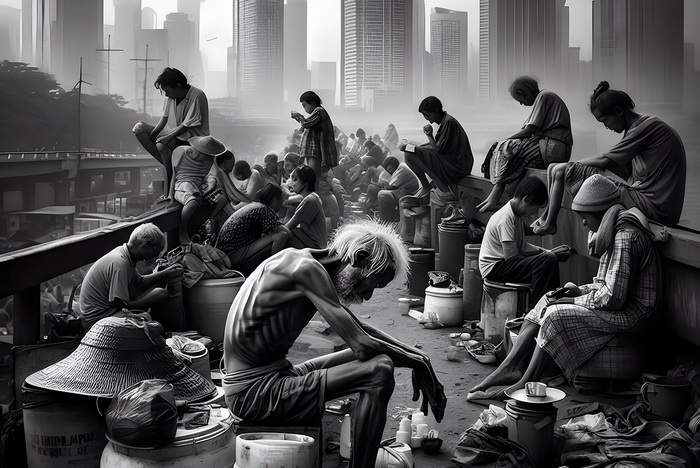
Agent Smith to Morpheus:
“Did you know that the first Matrix was designed to be a perfect human world? Where none suffered, where everyone would be happy. It was a disaster. No one would accept the program. Entire crops were lost. Some believed we lacked the programming language to describe your perfect world. But I believe that, as a species, human beings define their reality through suffering and misery. The perfect world was a dream that your primitive cerebrum kept trying to wake up from. Which is why the Matrix was redesigned in this way.”
from “The Matrix”, 1999
Are you addicted to drugs? No? Think again. Do you smoke? Drink hard liquor? Beer? Coffee? Do you overeat? Aren’t tobacco, alcohol, and coffee addictive drugs? What about fast food, so-called junk food? Sugary drinks? Chocolate?
(Note: Cocoa is an alkaloid that produces a molecule which binds to the body’s opioid receptors through a mechanism similar to that of heroin. It produces pleasure, is addictive, and it is no coincidence that when people face relationship problems, many try to compensate by turning to sweets…)
So, from this perspective, we can all consider ourselves, in a certain sense, addicted to drugs, even if, of course, we don’t like to admit it. However, this is not the point that interests me, but rather the mechanism that created this addiction.
The Mechanics of Addiction: From Disgust to Need
Think for a moment about the first time you smoked a cigarette or drank a glass of whiskey: what was your reaction? Enthusiasm? Pleasure? Did you say to yourself: “Wow, what a sensational experience. This is what I’ve always wanted. From now on, I’ll keep drinking and smoking with the greatest pleasure.”
Did it go like that? I don’t think so. Anyone who first comes into contact with tobacco or alcohol has a reaction of disgust. The body signals with all its might: “Poison! Be careful!”
And we can’t understand what others find so enjoyable about it. However, social pressure comes into play—the fact that everyone smokes and drinks—and the consumption of tobacco and alcohol becomes a sort of rite of passage into adulthood. In short… after a while, the sensation isn’t so repulsive anymore; the body is extraordinarily resilient and develops a series of defense mechanisms.
But what is most extraordinary—and what I ask you to reflect on—is that after this period of adaptation, what was once perceived as a danger to be fled from becomes something tolerable and, ultimately, a need we cannot do without. Needless to say, despite the change in perception, the physical damage continues, and when, sooner or later, we find ourselves suffering from lung cancer or liver cirrhosis, it is too late to do anything.
All these things are well known, and despite the benefits felt immediately after a few days of abstinence, it is very easy to relapse into addiction, as anyone who has tried to quit smoking or drinking coffee knows.
A similar mechanism also applies to foods that we might not readily define as drugs, but which are nonetheless harmful and addictive.
We are so accustomed to drinking sweet, carbonated soft drinks from childhood, for example, that we perceive them as something completely natural; yet, try drinking only water for a few months: after this period, just a sip of Coca-Cola will have the same effect on you as a teaspoonful of sugar!
However, I haven’t made this whole speech to launch a campaign against smoking and alcohol, but to describe the mechanism that comes into play even when it comes to mental states.
Often, when talking about ourselves, we describe ourselves as unmotivated, indecisive, anxious, depressed, short-tempered, or nervous, as if these characteristics were part of who we are. In the same way, we allow negative thoughts, criticism, and self-justification to dominate our minds.
Learned Disability: Why We Choose to Fail
Now, it may be difficult to accept this fact, but these mental states, which seem inextricably linked to our very being, are not natural at all—no more so than tobacco or alcohol intoxication.
Depression or indecision are not natural states, but defense mechanisms we have developed to respond to and control our environment in a certain way. Criticism is not an innate behavior, but a pattern we have developed to defend ourselves against the criticism of others.
A child isn’t depressed or indecisive; a child doesn’t lack motivation, and doesn’t give up on their goals. Imagine a child who is learning to walk and who, after falling two or three times, says to themselves: “I’ll never be able to do this; there’s no point in trying—I’d better stay where I am and keep crawling!”
Have you ever seen a child like that? Can you imagine a child who lacks self-confidence? A child who blames others if they can’t do something? Or a child who criticizes?
The Inner Child: Your Natural State of Being
Let’s remember—because we’ve all been children—our ability to explore, to try, to accept falls and get back up, to act without wondering if we should get everything right on the first try, or avoid criticism, or prove something…
But here is where the diabolical mechanism we saw in relation to addictions comes into play: we discover negative thinking, laziness, and a lack of motivation (have you ever seen a lazy child?). And we discover that from time to time these can be convenient ways to escape a duty, a responsibility, a punishment, or a task.
After all, why take action and risk failure when it’s more comfortable to stay safe in our shell? Why risk discovering new paths when it’s more comfortable to follow others’ and criticize what’s been done? Such thoughts are pure poison for the mind and for personal development, but, as with drugs, after a while the brain gets used to it and ends up becoming addicted.
Not only that, but “giving up before even trying” becomes part of who we are; it becomes something that defines us as people. The same goes for any other thought whose sole purpose is to avoid confrontation, growth, and self-awareness.
Breaking the Habit: Recognizing Parasitic Emotions
I can’t write a psychology treatise here, but every time you feel a negative emotion, a doubt that paralyzes you, a fear that prevents you from acting, remember that it is something you have LEARNED; it is not something NATURAL; it is not something that is part of you.
It is a poison your mind has grown accustomed to and from which it can no longer free itself. Although there are no simple solutions—just as there are none for breaking free from drugs—the simple act of realizing that these are “parasitic” feelings and not something that is part of us can be a first step toward liberation from this particular addiction.
It is possible that we are so accustomed to a miserable life that we have difficulty imagining a different one,but any 2-year-old child shows us that another way of living is possible.
Why not give it a try?
by Bruno


