
Uniqueness, Charisma, and Absolute Freedom
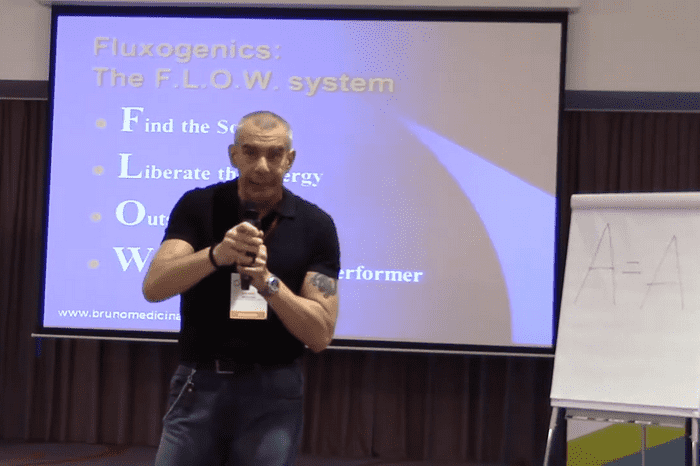
Conducted in May 2015, ahead of the Lead Your Life conference. Interview by Cristina Ivan, published on the event site
—-
Bruno Medicina talks about what lies beyond performance and immediate results, what real competence means, how to define success on your own terms, and why uniqueness, freedom, and vision matter more than conformity.
Bruno Medicina is a performance coach, trainer, author, and speaker with more than 30 years of experience in personal development and a background spanning business, psychology, music, and sport.
He shares both personal and professional experience with an unconventional approach, using talks and training sessions to help people discover their potential and improve performance in different areas of life.
Beyond the standard training repertoire, he developed a series of original seminars that included high-impact experiences such as Firewalking (Fire Up Your Power Seminar) and Boardbreaking (FLY – Find the Leader in You), together with programs exploring Evolutionary Psychology, Game Theory, Neuromarketing, and Memetics.
At the time of this interview, his most recent program was “Flowing to Success: The F.L.O.W. System,” based on research into the flow state and its applications in business, sport, and everyday life.
The Predator’s Way model brought together many of the themes he had been researching for years: identity, potential, performance, freedom, and the possibility of reconnecting with what makes each person unique.
Theory, practice, and real competence
Cristina Ivan: You know and do so many things: you’re a performance coach, trainer, consultant, author, and speaker; you practice martial arts and have studied music and philosophy. How did you begin this journey of self-discovery? What motivated you to get to know yourself? What inspired you?
Bruno Medicina: Many things just came naturally. There’s nothing that particularly inspired me. I’ve read a lot since childhood, but I was a disaster in school. Yes, I studied at the Conservatory, but the degree itself was of no use to me. The same goes for my studies in philosophy. I’ve always been the kind of person who thinks really hard about things, trying to see beyond what’s obvious. So, in my quest to enhance my performance, I constantly asked myself two questions: “What is performance, beyond just results?” and “What can be improved?” As a result, I’ve always tried to learn from the best.
This shaped a way of thinking that bothers a lot of people. For example, as a matter of principle, I’m wary of people who show up with a stack of diplomas. Obviously, serious preparation in any field is extremely important, but sometimes people hide behind credentials so that what they know cannot be questioned. It’s like putting on a black belt in the hope of intimidating your opponent so you won’t actually have to fight.
Cristina Ivan: It’s about the conflict between theory and practice. Which has the upper hand: theory or practice?
Bruno Medicina: That’s the age-old question, but I think it’s badly framed. For every decision and every action, we need some kind of theory—a model of cause and effect. If the theory doesn’t match practice, it simply means the theory is wrong. The problem is not theory itself, but the fact that some people—especially in the education system, though not only there—keep repeating theories they have read without ever testing them in practice.
Gustave Le Bon made a point I would summarize this way: books are extremely useful, but they also carry a danger—they can create a false sense of competence. The conflict between theory and practice becomes destructive when, after earning a degree, you start to believe that what you know can no longer be questioned. If you’re pursuing performance in a field where reality gives you constant feedback—as in sales, business, or sport—a degree becomes largely irrelevant. And in fields that change quickly, what worked yesterday may no longer work today.
Many people, especially in Romania, are obsessed with diplomas. They have so little confidence in themselves that they feel worthless without those pieces of paper. They display diplomas with the same enthusiasm with which they display gold chains or expensive cars. I believe, instead, that each of us proves our value every day through the results we produce. If you’ve read a lot of books, fine—but if you’ve never tested what you learned in the field, it is of little use. That applies whether we’re talking about yoga, philosophy, literature, or a technical skill.
In short, learning something means changing your behavior. If you’ve read or know a million things but none of them changes what you actually do, the knowledge is useless. If I read extensively about nutrition and continue eating junk food, all that reading does not make me healthier.
Success, leadership, and uniqueness
Cristina Ivan: How do performance and skills relate to the idea of success? Are they part of success? How would you define success?
Bruno Medicina: In Italian, the word successo is also the past participle of “succedere”, “to happen.” So, in a very literal sense, whatever has happened is already a “success.” The real question is whether what happened is what you wanted to happen. If it isn’t, you experience it as failure.
Society imposes a model of success on us that serves its own interests. Society needs people who keep running, producing as much as possible and checking off as many tasks as possible. I chose a qualitative approach rather than a quantitative one. Success simply means living the way you want to live. As Nietzsche argued, if you spend eight hours a day doing work you hate, you are a slave regardless of how much money you earn. If my idea of success is sitting in the sun with a book and I manage to do that, that is success. I’ve built a lifestyle that suits me.
Cristina Ivan: Now that we’ve defined success, I’d like you to help me define leadership as well. How difficult is it to be a leader in a conformist society?
Bruno Medicina: We’re talking about something serious. Being a leader does not simply mean being obeyed in an office; that is management. Leadership means having a vision of the future that other people find compelling and worth moving toward. In a world that often has no idea where it is going, a leader offers a vision that has meaning for others.
The central quality of a leader is charisma, in the original sense of manifesting the gifts you have been given. The foundation of authority is the recognition that there is something greater than your own ego. When you discover that higher principle and align yourself with it, you can lead. No major leader in history has led purely in his or her own name; leaders claim to act in the name of religion, a people, history, democracy, or some other larger cause.
A leader can disturb a system simply by changing it. The better you become, the more resistance you may trigger. A vision needs time to become reality, and obstacles are inevitable: time, money, bureaucracy, lack of resources, and so on.
Cristina Ivan: What does it mean to be exceptional and original in a world focused on skills and competition?
Bruno Medicina: The word competition comes from Latin roots associated with striving together toward the same thing. In practice, competition often becomes a zero-sum game: if I obtain something, you do not. Sometimes that really is the situation. We live in a society that is egalitarian in principle and competitive in practice.
The only competition that really matters is with yourself. Each of us has our own abilities, potential, and a unique combination of talents. Unfortunately, society tends to promote a single model of success: work eight hours a day so that the organization you belong to can prosper, and if you do not play that game you risk being labelled a failure.
We live in a standardized, bureaucratic world. The defining feature of bureaucracy—whether in a company, a family, a country, or any other structure—is that people and functions are expected to be replaceable. The conventional idea of performance can become bureaucratic too: it measures you against predefined standards and confines you within established structures. The value you can bring that no one else can duplicate is your uniqueness. Your particular mix of talents, skills, experiences, abilities, and even limitations makes you unique. In a world that tries to fit you into molds, your uniqueness is your value. We are all unique and original, but we often hide it. Of course, context matters: inside a structure you cannot ignore every rule, but you can still express your creativity in ways that help the structure.
Freedom, choice, and the limits we create
Cristina Ivan: How do you figure out what your personal goal is if someone or something else is always setting goals for you—your job, your family, or some other structure?
Bruno Medicina: It’s up to you whether you want to pursue those imposed goals. One of the greatest discoveries is realizing that you have no absolute obligations. I use an exercise in my courses: I ask participants to make a list of everything they have to do during the next two months. Many come back with very long lists. Then I tell them I’m not interested in the list, because strictly speaking they do not have to do any of those things: nobody can force you to work, go to school, or get married.
Freedom is absolute, but there are consequences. And what people often want to escape is not the choice, but the consequences. If you do not like the consequences, you may need to reconsider the choice that produced them. No one can make the fundamental choice for you. The amount of freedom we actually have is extraordinary.
Cristina Ivan: How do you figure out what you want?
Bruno Medicina: We return to an old philosophical maxim: know thyself. People often do not know what they want because they do not know themselves. In a society where you are bombarded with desires, offers, expectations, and obligations, you rarely stop long enough to say, “This is what I want.”
The only solution is to stop and think. What is your goal? What is the unique contribution you can offer the world? To discover it, you have to look deeply into yourself, but the surface has to be like a calm lake. If the water is constantly disturbed, you cannot see what lies beneath. The meaning of life is to find the meaning of life. You have to find that meaning for yourself. Everything in the universe may have a function or a place, but the meaning of your life is ultimately the meaning you give it.
Cristina Ivan: How does the idea of freedom relate to transcending limits?
Bruno Medicina: Overcoming a limit is, by definition, impossible: if you overcome it, then it was not a true limit in the first place. And that is exactly the point—we create an enormous number of false limits for ourselves. We impose obligations and boundaries that exist mainly in our minds.
When we talk about exploring potential, one clarification is important: the fact that a potential exists does not mean it must be expressed. We all have the potential for destructive behavior, corruption, violence, and many other things; that does not mean we should manifest those possibilities. From the enormous range of possibilities available to us, we choose the ones that are consistent with who we want to be.
So you ask: Who says this is true? Where did this belief come from? How can I test whether this limit is real? And remember that the process works in both directions: sometimes you are convinced something is impossible and then discover that it can be done; other times you are convinced something is possible and reality gives you a hard correction. You have to focus on what you can do, and your mental model has to remain accountable to reality.


